By / Feng Wei (Co-founder, Bojun Technology)
Pain Points at a Glance: Allocation Challenges Are Not Just the Merchandise Department's Problem
In today's stressed fashion industry, standing invincible is no easy feat. Even with strong production capabilities and quality products, many brands are tripped up by merchandise management challenges — persistently high stockouts, disappointing sell-through rates, and slow turnover.
The root causes go far beyond a single merchandise department's poor performance — they involve a "full-chain collaboration" issue spanning planning, sales, supply chain, and front-line stores. When assessment pressure is inappropriately focused on the merchandise department, expecting them to "cover for all outcomes," digitalization tools, however heavily invested, often fail due to overlooking the cross-interaction of multiple factors.

![]()
Efficiency First: Streamlining the Chain Is the Optimal Starting Point of Digitalization
Driving efficiency improvement is the urgent priority for straightening out the merchandise chain. For merchandise teams on the front lines, the most basic demand is efficiency: How to support a larger scale with existing manpower? How to respond faster to market demand? How to accelerate merchandise flow? Whether improving sell-through rates, full-price sell-through rates, optimizing turnover, or reducing stockouts — all these core goals must be built on the solid foundation of "efficient merchandise chain operation."
We believe the first step in digitalization is not pursuing complex systemic transformation, but focusing on efficiency improvement — the most core, most fundamental, and most immediately effective entry point. Only by first freeing merchandise people from tedious, repetitive, low-value tasks and giving them space to think and explore can we achieve the most maximized ROI breakthrough.

![]()
Implementation Path: Small Steps, Rapid Execution, and Practical Battle Testing Confidence
Burgeon's SAC Allocation & Replenishment solution doesn't advocate a grand "one-step" platform revolution, but insists on "small steps, rapid execution, and practical battle testing."
In the early stage, priority might be given to links with clear processes, definite evaluations, and short feedback cycles — perhaps a streamlined core transfer rule, or an optimization of a key replenishment logic. The goal is very clear: let the merchandise team genuinely feel time and labor savings and see results in the short term, rapidly building confidence and driving the project into a virtuous cycle of self-reinforcement.
![]()
Each enterprise's subsequent advancement direction varies: some are deepening rule optimization, some urgently need to break down barriers between merchandise, marketing, and operations, and some need to trace back to solve merchandise planning problems at the source. We respect this diversity, always navigating with "what's the fastest next step to show results," ensuring each improvement is reusable, effective, and promoting overall merchandise digitalization in an incremental, snowball-style optimization.

"Speed + Safety": Burgeon SAC's Real Product Value
The product methodology behind this practice is clearly anchored at the two value pillars of "Speed" and "Safety" — especially fitting the pragmatic and steady needs of the vast majority of brands today.
![]()
"Speed" is velocity — we have achieved 100% of projects going live within one month, and over half of enterprises can run through their business in just two weeks.
"Safety" is confidence — this refers not only to system security but to ensuring that every unit of the enterprise's investment has clear and verifiable returns, guaranteeing that time and resources are not wasted. To this end, we pioneered the "White-Box" design philosophy, forming a sharp contrast with common "black-box algorithms" on the market.

![]()
Transparent Mechanism: White-Box Design, Goodbye to Black-Box Algorithms
Traditional allocation & replenishment tools often fall into the algorithm "black box" — enterprises cannot understand the logic behind outcomes and can only passively accept results. Burgeon SAC's "Six-Step Supply-Demand Balance Method" and other core mechanisms are committed to structuring and parameterizing every rule and operational concept of the enterprise, ensuring that every decision the system outputs can be clearly traced back and mapped to specific rule sources. What enterprises see is not only the result but the entire process of logical derivation. This unprecedented transparency and verifiability bring tangible control and security, setting reasonable, achievable project expectations.
Thanks to this, our project acceptance has been exceptionally smooth — enterprises can verify the system's usability and accuracy in daily operations, requiring no lengthy persuasion process. To date, all allocation & replenishment projects have been successfully accepted as planned, delivering on the promise of "fast launch, truly effective."

![]()
Beyond a Tool: Building the Future-Ready Merchandise Digitalization Foundation
Doing a single allocation & replenishment tool well is just the starting point. To build a future-ready merchandise operations system requires a complete solution integrating methodology and system capabilities. We position the allocation & replenishment system as a solid "merchandise digitalization foundation." It is no longer merely a tool but an extensible, integrable, and steadily evolving open platform. In the future, whether it's AI-driven precise forecasting, automated decision-making, or efficient cross-role collaboration and seamless multi-system integration, this foundation has strong inclusiveness — truly becoming the core digital operations system for enterprise merchandise teams.
We practice an open ecosystem strategy. For example, seamlessly connecting the high-precision sales forecasting capabilities of an AI company specializing in this area to our rule engine enables enterprises to make more forward-looking and precise merchandise judgments through the "forecasting + rules" dual-engine approach. This is a connection-based collaborative ecosystem philosophy that transcends closed-loop limitations.
![]()
Going further, we are collaborating with research institutions to build a "merchandise operations capability evaluation system." This is not for ranking but to help enterprises objectively assess their merchandise teams' true capabilities and precisely identify improvement dimensions. Just as AI has its evaluation models (Benchmarks), the merchandise digitalization field equally needs an industry-consensus evaluation framework to drive inter-enterprise benchmarking and overall industry digitalization capability upgrading.
This is not just a product project but a weighty industry responsibility. On this road, we are willing to walk steadily, dig deep, and ensure every step is impactful — injecting solid confidence and lasting value into the industry.
![]()
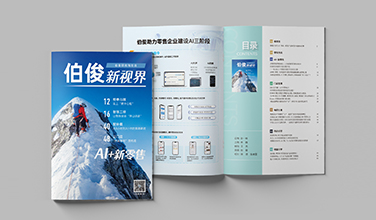
This article is featured in Burgeon New Vision, edited-in-chief by Sun Yihui, Chairman of Burgeon Technology, and produced by Burgeon Research Institute.





 2026/06/21 周日 22:16