By / Gao Rong (Dean, Burgeon Academy)
The Burgeon Research Institute's recently published industry report "AI-Driven Retail Nirvana: CIO's Omnichannel Retail and Intelligent Growth Strategic Blueprint" points out that retail enterprise AI transformation does not happen overnight — it clearly divides into three progressive phases: Data Foundation, Process Efficiency, and Model Innovation.
Today, we focus on Phase Two — Process Efficiency. When an enterprise has completed initial data governance and system integration, the next battle is to use AI as a "surgical blade" to precisely scan and reshape complex business processes.

![]()
I. Why "Process"?
Over the past decade, all innovation in China's retail industry has essentially been "channel innovation." From offline stores to e-commerce platforms, and then to live streaming and private domain — each channel expansion brought new growth while leaving behind more complex process breakpoints and data silos.
![]()
Which channel does the order come from? Which warehouse should fulfill it? How do membership benefits connect across channels? How should settlements be accurately split? These seemingly basic business processes have become the biggest black holes consuming efficiency, inflating costs, and impacting experience in today's fragmented channel landscape.
The core problem of all retail enterprises is inventory. And behind the inventory problem lie countless fragmented, inefficient, human-judgment-dependent processes.

![]()
II. Traditional Workflows Are Being Redefined
As a digital service provider deeply rooted in the retail industry for 26 years, Burgeon has served over 5,000 retail brands. We have witnessed the entire evolution of business processes from paper-based to system-driven to today's intelligent era.
Traditional ERP or middle platforms define "how a process should flow." But in the AI era, the ownership of process definition is shifting from "system-preset" to "real-time business-driven." It is no longer a rigid assembly line, but an intelligent entity capable of sensing, deciding, executing, and self-optimizing.
![]()
What does this mean?
From "People Find Tasks" to "Tasks Find People": The system can automatically alert on inventory anomalies, identify fulfillment bottlenecks, and push tasks to the most suitable person.
![]()
From "Process Rigidity" to "Dynamic Orchestration": When faced with unexpected scenarios like a live-streaming sales surge requiring rapid store fulfillment, the system can automatically combine order, inventory, and logistics processes to achieve optimal fulfillment.
From "Experience-Driven" to "Data-Driven": Replenishment, allocation, and pricing no longer depend on store manager experience, but on AI models that provide suggestions based on real-time sales, weather, competitor activities, and other multi-dimensional data.
![]()
This is precisely the direction Burgeon continues to evolve its omnichannel business middle platform and intelligent OMS products: building omnichannel transaction capabilities that adapt to any change. No matter whether an order originates from Tmall, Douyin, or a mini-program, and no matter whether the goods are in a central warehouse, store, or cloud warehouse, the system can automatically receive orders, intelligently dispatch, and settle precisely.

III. Industry Pain Points: The "Invisible Ceiling" of Efficiency
A set of data from the "AI-Driven Retail Nirvana" report reveals widespread industry anxiety: Retail executives expect AI's contribution to revenue growth to increase by 135% by 2027. However, 71% of retailers believe cost is the biggest barrier to integrating generative AI.
![]()
The contradiction: Enterprises know AI is the future, yet are trapped in the present — unsure where to invest money to achieve real efficiency.
The report further notes that retail AI budgets are growing at 19%, and 51% of that growth comes from outside the IT department. This sends a strong signal: Business departments' hunger for efficiency has outpaced technology procurement. Merchandise, marketing, and operations teams no longer settle for passively using tools, but are actively seeking AI solutions that directly optimize their core work.
The pain point is clear: Enterprises don't lack systems — they lack processes that can connect systems, span businesses, and continuously self-optimize as "intelligent processes."

IV. Industry Practice: From "Single-Point Breakthrough" to "Holistic Optimization"
Process efficiency is not empty talk — it happens in every specific business scenario.
Case 1: Luxury's "Process Mining" Revolution
For high-end fashion brands, customer service experience is paramount. By introducing Process Mining technology, we conducted an in-depth examination of the entire chain of order fulfillment and customer complaint handling. AI, like an X-ray, precisely identified redundant links and anomalous paths causing delays. Through subsequent automated interventions, the brand successfully reduced average customer service issue resolution time by 90% and cut per-incident resolution cost by 46%. This validates our view: Hyperautomation should not start blindly — process mining is the first step toward precise, high-ROI operational optimization.
Case 2: From "Forecasting Failure" to "Smart Replenishment"
Accurate sales forecasting in the apparel industry was once jokingly called ""an impossible mission,"" influenced by countless non-linear variables including weather, trends, and social media. In the process efficiency phase, enterprises began applying AI large models to this challenge. AI-based solutions can fuse historical sales data, real-time weather, regional heat maps, and even viral Xiaohongshu posts to generate dynamic replenishment recommendations. While not yet 100% accurate, its ability to enable rapid mid-season response and reduce both stockout and overstock risks has far surpassed traditional human experience. Essentially, this reshapes the decision-making phase of the core business process of ""merchandise planning — procurement — replenishment.""
Case 3: Making Every Sales Associate a "Super Individual"
In stores, complex POS operations and membership systems were once a nightmare for new employee training. Burgeon's "AI Assistant" transforms system operations into natural language dialogue. Sales associates simply say "Check if this shoe has a size 36 in stock" or "Add points for member Mr. Zhang," and the system automatically completes the query or operation. This compresses dozens of hours of training into "one sentence." This is not merely a tool upgrade — it reshapes the "service process" from rigid click sequences into a more human and efficient interactive experience.

V. Process Wins — Winning on the Second Curve
AI transformation's second phase — "Process Efficiency" — is a silent but profound efficiency revolution. Its goal is not to overturn, but to optimize; not to replace people, but to empower them.
By deeply embedding AI into every business process node — from merchandise forecasting and intelligent fulfillment to store operations and customer service — enterprises can:
Cut hidden costs: Reduce manual intervention, lower error rates, optimize inventory turnover.
Enhance operational resilience: When facing unexpected traffic spikes or supply chain disruptions, the system can automatically dispatch resources to keep business running smoothly.
Unleash talent value: Free employees from repetitive, tedious tasks so they can focus on creative marketing, service, and customer relationship management.
What accumulates through this process is not only short-term cost reduction and efficiency gains, but also the organizational muscle memory and data assets enterprises need to face the future ""Model Innovation"" phase. When processes are intelligent enough and data flows smoothly enough, innovation is no longer a risk — it comes naturally.
The era of process-first efficiency has arrived. Is your enterprise ready to use AI to rebuild all business processes?
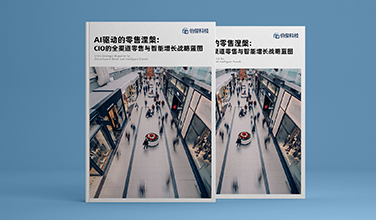
This article is based on core insights from the Burgeon Research Institute's "AI-Driven Retail Nirvana: CIO's Omnichannel Retail and Intelligent Growth Strategic Blueprint." The report details the three-phase model of retail AI transformation and includes more industry data, trend analysis, and complete customer case studies.





 2026/07/03 周五 10:08