Recently, the term “lobster” has gone viral across the industry. Everyone is discussing OpenClaw’s cross-device interactive capabilities. What truly excites people is that, once granted permissions, it can directly operate computers. This boundless vision is undoubtedly inspiring.
However, as solution providers, we have found that clients care little about underlying technical principles. What they really want to know is: how can this “lobster” integrate with real business operations? Many enterprises have independent budgets for AI initiatives, yet remain unsure about how to transform into AI-powered organizations.
The launch of BurgeonClaw creates a pathway for enterprise AI adoption analogous to learning to drive: advancing step by step from Subject 1 all the way to Subject 4.
I have summarized four progressive phases for enterprises leveraging BurgeonClaw, to illustrate tangible business outcomes this AI agent can deliver.
The first stage of enterprise AI transformation is Initial Experience, centered on automating routine chores for employees. Our goal is to let every team member perceive AI at their fingertips and reap its benefits anytime.
Take email management, a task that often creates overwhelming workloads. Many business professionals arrive at their desks each morning facing more than 100 accumulated messages received after work. The traditional workflow involves sorting, reading, reviewing context, and drafting replies — frequently consuming a minimum of two hours.
With BurgeonClaw, staff can send instructions to AI while commuting. The AI automatically organizes emails, extracts key information, drafts response templates, and generates a to-do list. When employees reach their workstations, they are no longer confronted with a cluttered inbox but a streamlined workspace. They only need to verify drafts and attachments before submitting replies with one click.
Expense reimbursement is another persistent pain point for companies with frequent business travel. Electronic invoices come with messy PDF filenames, forcing employees to manually download, preview and categorize files, which easily leads to mounting stress. AI can automatically scan emails, download attachments, rename documents following defined rules and archive them. More intelligently, it carries out data verification and automated statistics. Based on invoice contents, it generates Excel sheets summarizing travel records and amounts to simplify subsequent submission and financial auditing.
Successfully delivering value at this stage builds genuine trust between employees and AI.
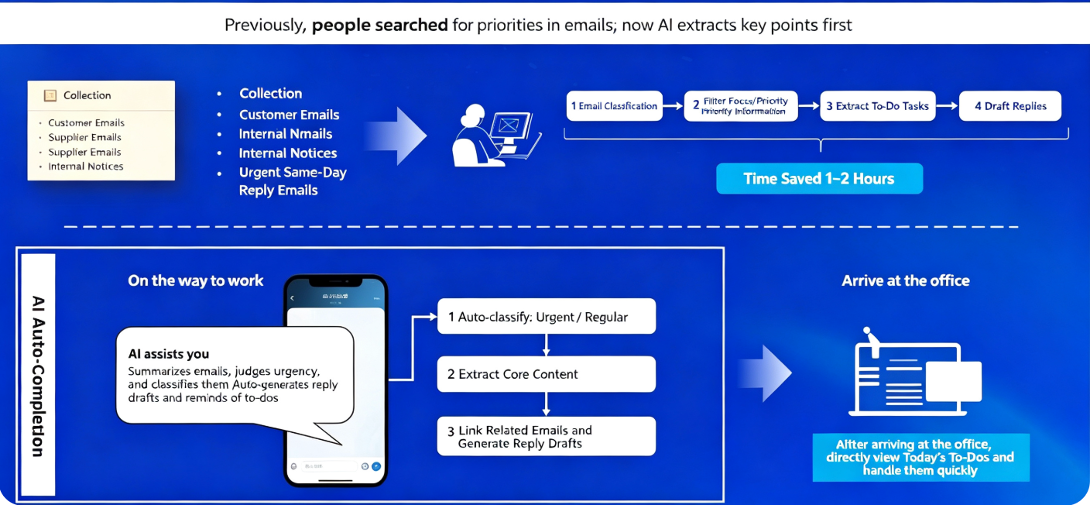
Moving on to the second stage, AI begins deep integration with business scenarios. At this phase, AI is no longer merely a task executor; it evolves into a junior business assistant.
In the past, when business staff needed to pull data during meetings, they had to repeatedly set filters in systems such as time frame, product category and color. Yet people naturally speak casually in real communication, for instance: “Check the stock level of that purple jacket for me.” The AI must comprehend such semantics and break down the request accordingly.
This is far from sufficient. We introduce a predictive reasoning mechanism at this stage. The AI will think: why are you checking this jacket? Is it facing slow sales, or do you aim to boost its turnover? If it identifies the item as a new arrival, it will proactively offer suggestions: “Spring is here, and camping and hiking are trending. It is recommended to bundle this outdoor hiking pant for cross-selling.”
This role transformation means AI has grown beyond a robot executing fixed instructions. It becomes a collaborative partner that understands business terminology and delivers thoughtful recommendations.
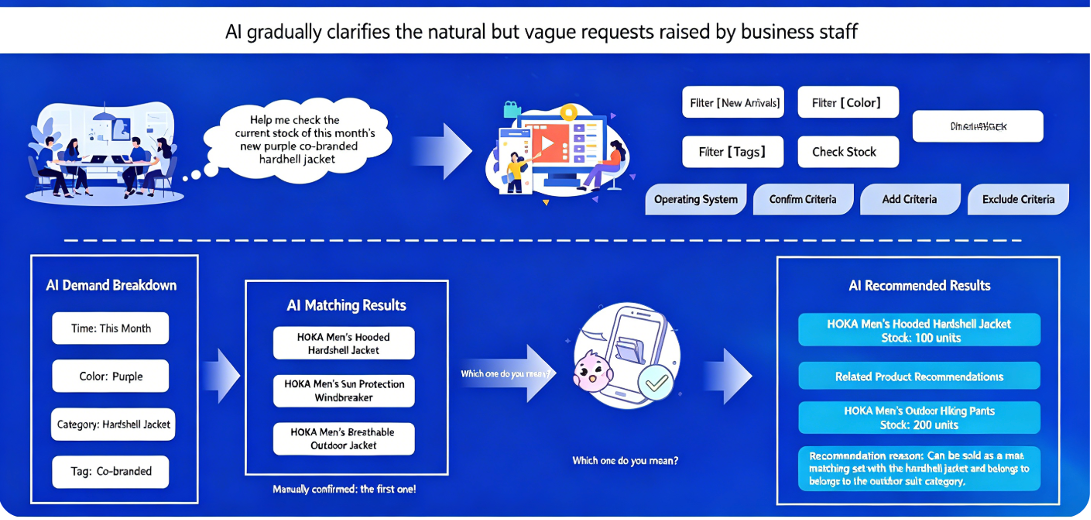
The goal of the third stage is to drive end-to-end business workflows and resolve process breaks stemming from divided departmental responsibilities.
Take the inventory sharing strategy as an example. It involves complex rules covering direct-operated stores, franchise outlets, e-commerce and other dimensions. Under the traditional model, multiple teams have to adjust allocation ratios, verify sellable scopes and synchronize inventory data, creating numerous bottlenecks. The underlying reason is straightforward: differing ownership of goods, inconsistent handling rules, and cross-functional online and offline operations, which lead to exorbitant communication costs among teams.
From the perspective of BurgeonClaw, it translates such business requirements into logical breakdowns. It can automatically identify the ownership of different inventories and intelligently assign tasks to corresponding modules including ERP, omnichannel platform and OMS.
Real-time monitoring serves as another critical capability. When anomalies such as potential overselling emerge, instead of merely generating an error report for manual troubleshooting, the AI can automatically mitigate risks and deliver direct outcomes. At this stage, AI connects fragmented procedures and forms closed-loop business operations.
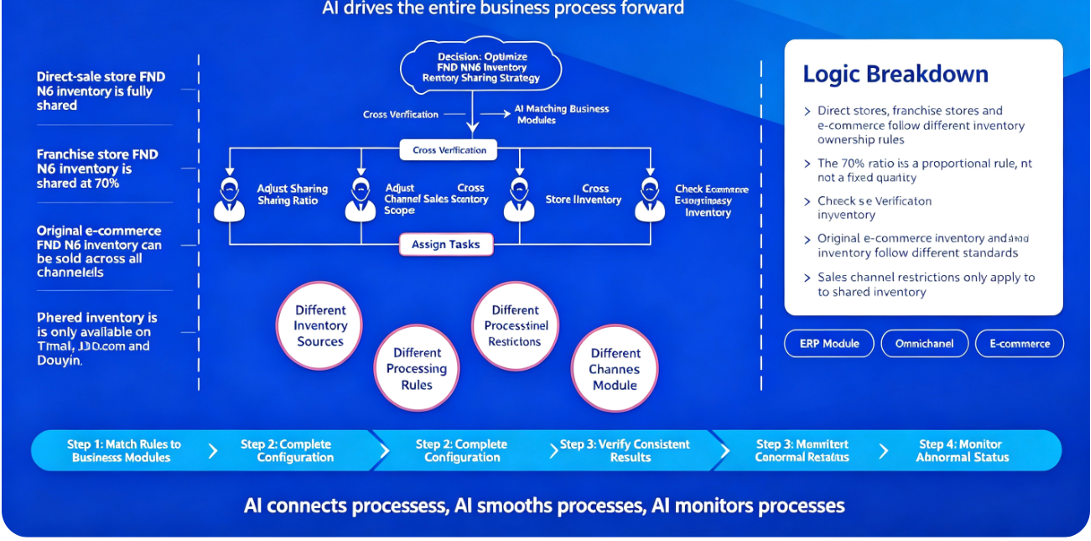
Upon entering the fourth stage, AI operates from the perspective of overall corporate management, penetrating all business links. Its core capability lies in breaking free from the constraints of a single system and functioning across barriers between different vendors.
Suppose an enterprise plans a group-wide promotional campaign covering in-store POS, mini-programs, e-commerce and other systems. A common pain point arises when POS is supplied by Burgeon, while the mini-program and e-commerce platforms come from third-party providers. In the past, operation teams had to configure campaign settings three times across separate systems. Any information inconsistency would trigger mismatched online and offline promotions, resulting in financial losses or public opinion risks.
Now the AI platform breaks down tasks accordingly. Where it identifies Burgeon POS systems, it executes operations directly. If a third-party CRM is equipped with its own agent, the platform transmits corresponding business Skills for configuration. For legacy OMS systems without built-in agents, it sends instructions via APIs for interaction.
This approach thoroughly connects the data chain. Regardless of system suppliers, the AI platform completes all relevant tasks and carries out post-event review and analysis. This represents the ultimate form of AI applied at the enterprise operation level.

Let us envision boldly: in the future, complicated interfaces of ERP, POS and even OMS may take a back seat. The primary entry point for business personnel will be the AI workspace.
Within this workspace lie categorized agents covering orders, inventory, members and more, alongside a Skill Marketplace embedded with accumulated brand business expertise. Staff do not need to worry about which system to operate. They only need to issue instructions, and the AI will match the corresponding agents and skills to deliver results directly.
Digital transformation was originally intended to standardize workflows. Yet in pursuit of standardization, many cumbersome manual operations were introduced. In the AI era, the visual design of systems matters far less than clear data and logical frameworks.
Arguably, the truly efficient systems of tomorrow are those whose interfaces rarely need to be accessed. Echoing the state of mastery in martial arts — free from reliance on the blade — workflows are fully driven by AI and agents. This stands as the highest realm of enterprise AI transformation.





 2026/04/09 周四 21:45